



A universal Language Server Protocol (LSP) server for dependency management across Cargo, npm, PyPI, Go, Bundler, Dart, Maven, Gradle, Swift, and Composer ecosystems.
- Intelligent autocomplete — Package names, versions, and feature flags
- Version hints — Inlay hints showing latest available versions
- Loading indicators — Visual feedback during registry fetches with LSP progress support
- Lock file support — Reads resolved versions from Cargo.lock, package-lock.json, poetry.lock, uv.lock, go.sum, Gemfile.lock, pubspec.lock, Package.resolved, composer.lock
- Diagnostics — Warnings for outdated, unknown, or yanked dependencies
- Hover information — Package descriptions with resolved version from lock file
- Code actions — Quick fixes to update dependencies
- High performance — Parallel fetching with per-dependency timeouts, optimized caching
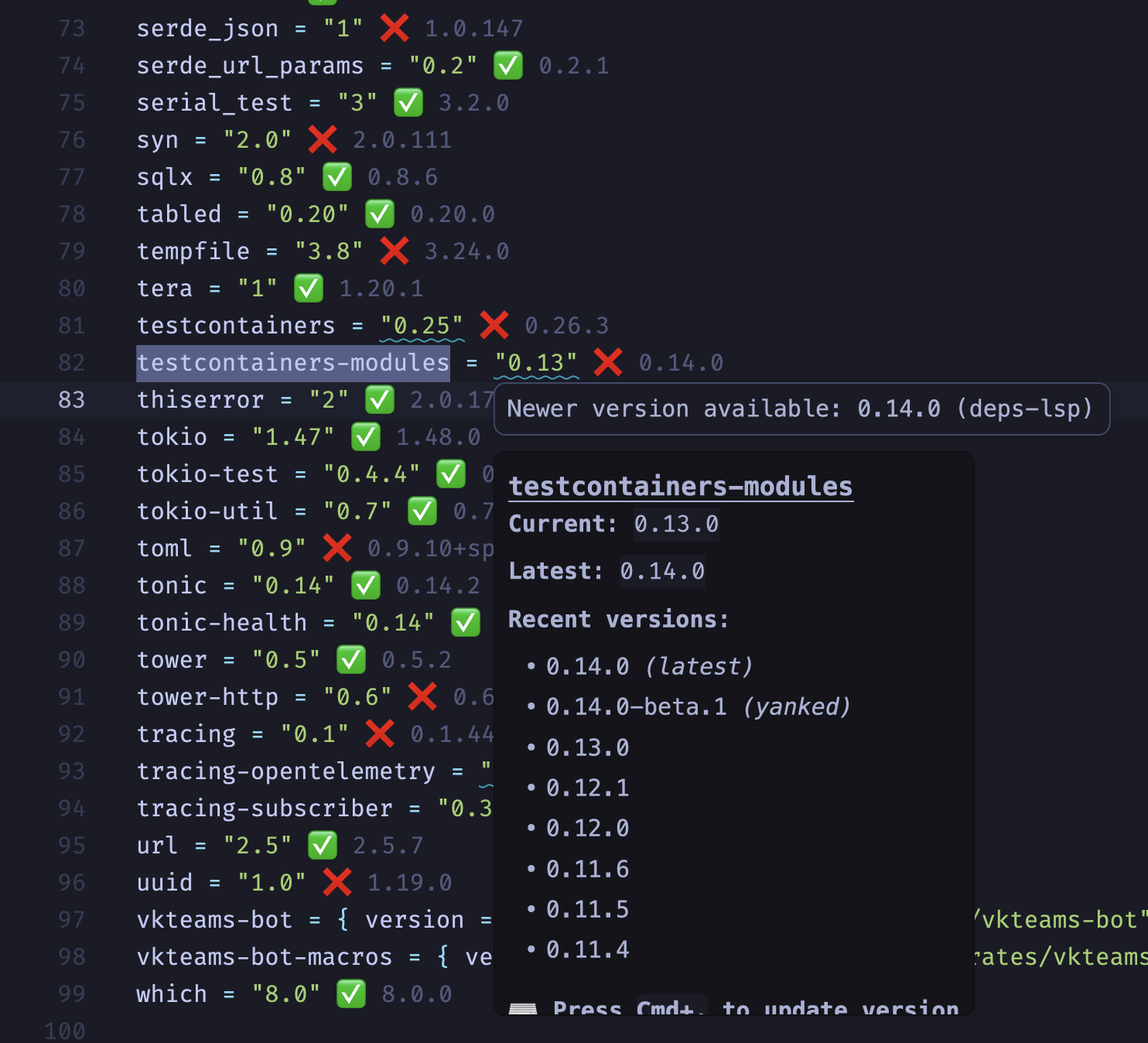
deps-lsp is optimized for responsiveness:
| Operation | Latency | Notes |
|---|---|---|
| Document open (50 deps) | ~150ms | Parallel registry fetching |
| Inlay hints | <100ms | Cached version lookups |
| Hover | <50ms | Pre-fetched metadata |
| Code actions | <50ms | No network calls |
Tip
Lock file support provides instant resolved versions without network requests.
| Language | Ecosystem | Manifest file | Status |
|---|---|---|---|
| Rust | Cargo | Cargo.toml |
✅ Supported |
| JavaScript | npm | package.json |
✅ Supported |
| Python | PyPI | pyproject.toml |
✅ Supported |
| Go | Go Modules | go.mod |
✅ Supported |
| Ruby | Bundler | Gemfile |
✅ Supported |
| Dart | Pub | pubspec.yaml |
✅ Supported |
| Java | Maven | pom.xml |
✅ Supported |
| Java | Gradle | libs.versions.toml, build.gradle.kts, build.gradle, settings.gradle |
✅ Supported |
| Swift | SPM | Package.swift |
✅ Supported |
| PHP | Composer | composer.json |
✅ Supported |
Note
Ecosystem details:
- PyPI — PEP 621, PEP 735 (dependency-groups), Poetry formats
- Go —
require,replace,excludedirectives, pseudo-version handling - Bundler — git/path/GitHub sources, pessimistic operator (
~>) - Dart — hosted, git, path, SDK sources, caret version semantics
- Maven —
dependencies,dependencyManagement,build/plugins, qualifier-aware version comparison - Gradle — Version Catalogs, Kotlin/Groovy DSL,
settings.gradleplugins; resolves from Maven Central, Google Maven, Gradle Plugin Portal - Swift — all
.package()forms (from, upToNextMajor/Minor, exact, range, branch, revision, path); versions via GitHub API tags - Composer —
require/require-devsections, Packagist v2 API with metadata de-minification, Composer-specific tilde semantics (~1.2=>=1.2.0 <2.0.0)
cargo install deps-lspLatest published crate version: 0.9.0.
Tip
Use cargo binstall deps-lsp for faster installation without compilation.
git clone https://github.com/bug-ops/deps-lsp
cd deps-lsp
cargo install --path crates/deps-lspDownload from GitHub Releases:
| Platform | Architecture | Binary |
|---|---|---|
| Linux | x86_64 | deps-lsp-x86_64-unknown-linux-gnu |
| Linux | aarch64 | deps-lsp-aarch64-unknown-linux-gnu |
| macOS | x86_64 | deps-lsp-x86_64-apple-darwin |
| macOS | Apple Silicon | deps-lsp-aarch64-apple-darwin |
| Windows | x86_64 | deps-lsp-x86_64-pc-windows-msvc.exe |
| Windows | ARM64 | deps-lsp-aarch64-pc-windows-msvc.exe |
By default, all ecosystems are enabled. To build with specific ecosystems only:
# Only Cargo and npm support
cargo install deps-lsp --no-default-features --features "cargo,npm"

# Only Python support
cargo install deps-lsp --no-default-features --features "pypi"| Feature | Language | Manifest | Default |
|---|---|---|---|
cargo |
Rust | Cargo.toml | ✅ |
npm |
JavaScript | package.json | ✅ |
pypi |
Python | pyproject.toml | ✅ |
go |
Go | go.mod | ✅ |
bundler |
Ruby | Gemfile | ✅ |
dart |
Dart | pubspec.yaml | ✅ |
maven |
Java | pom.xml | ✅ |
gradle |
Java | libs.versions.toml, build.gradle.kts, build.gradle | ✅ |
swift |
Swift | Package.swift | ✅ |
composer |
PHP | composer.json | ✅ |
Run the server over stdio (typical editor integration):
deps-lsp --stdioTip
Configure your editor to launch deps-lsp and connect over stdio. See the editor snippets below.
Important
Inlay hints must be enabled in your editor to see version indicators. See configuration for each editor below.
Install the Deps extension from Zed Extensions marketplace. Ruby support is enabled for Gemfile files.
Enable inlay hints in Zed settings:
// settings.json
{
  "inlay_hints": {
    "enabled": true
  }
}require('lspconfig').deps_lsp.setup({
cmd = { "deps-lsp", "--stdio" },
filetypes = { "toml", "json", "gomod", "ruby", "yaml", "xml", "swift", "php" },
})
-- Enable inlay hints (Neovim 0.10+)
vim.lsp.inlay_hint.enable(true)For older Neovim versions, use nvim-lsp-inlayhints.
# ~/.config/helix/languages.toml
[[language]]
name = "toml"
language-servers = ["deps-lsp"]

[[language]]
name = "json"
language-servers = ["deps-lsp"]

[language-server.deps-lsp]
command = "deps-lsp"
args = ["--stdio"]
Enable inlay hints in Helix config:
# ~/.config/helix/config.toml
[editor.lsp]
display-inlay-hints = trueInstall an LSP client extension and configure deps-lsp. Enable inlay hints:
// settings.json
{
  "editor.inlayHints.enabled": "on"
}Configure via LSP initialization options:
{
  "inlay_hints": {
    "enabled": true,
    "up_to_date_text": "✅",
    "needs_update_text": "❌ {}"
  },
  "diagnostics": {
    "outdated_severity": "hint",
    "unknown_severity": "warning",
    "yanked_severity": "warning"
  },
  "cache": {
    "enabled": true,
    "refresh_interval_secs": 300,
    "fetch_timeout_secs": 5,
    "max_concurrent_fetches": 20
  },
  "loading_indicator": {
    "enabled": true,
    "fallback_to_hints": true,
    "loading_text": "⏳"
  },
  "cold_start": {
    "enabled": true,
    "rate_limit_ms": 100
  }
}| Section | Option | Default | Description |
|---|---|---|---|
cache |
fetch_timeout_secs |
5 |
Per-package fetch timeout (1-300 seconds) |
cache |
max_concurrent_fetches |
20 |
Concurrent registry requests (1-100) |
loading_indicator |
enabled |
true |
Show loading feedback during fetches |
loading_indicator |
fallback_to_hints |
true |
Show loading in inlay hints if LSP progress unsupported |
loading_indicator |
loading_text |
"⏳" |
Text shown during loading (max 100 chars) |
Tip
Increase fetch_timeout_secs for slower networks. The per-dependency timeout prevents slow packages from blocking others. Cold start support ensures LSP features work immediately when your IDE restores previously opened files.
Some ecosystems (Swift) resolve versions via the GitHub API, which is limited to 60 requests/hour without authentication. Set GITHUB_TOKEN to increase the limit to 5,000 requests/hour:
# Using GitHub CLI (recommended)
export GITHUB_TOKEN=$(gh auth token)

# Or create a personal access token at https://github.com/settings/tokens
# No scopes required for public repository access
export GITHUB_TOKEN=ghp_...
For Zed, launch with the token so the LSP process inherits it:
# bash / zsh
alias zed='GITHUB_TOKEN="$(gh auth token)" command zed'

# fish
alias zed='env GITHUB_TOKEN=(gh auth token) command zed'
Tip
Add the alias to your shell profile (~/.zshrc, ~/.bashrc, ~/.config/fish/config.fish) for persistence.
Important
Requires Rust 1.89+ (Edition 2024).
cargo build --workspace# Run tests with nextest
cargo nextest run
# Run tests with coverage
cargo llvm-cov nextest
# Generate HTML coverage report
cargo llvm-cov nextest --html# Format (requires nightly for Edition 2024)
cargo +nightly fmt --check
# Clippy (all targets, all features)
cargo clippy --workspace --all-targets --all-features -- -D warnings
# Security audit
cargo deny checkdeps-lsp/
├── crates/
│ ├── deps-core/ # Shared traits, cache, generic handlers
│ ├── deps-cargo/ # Cargo.toml parser + crates.io registry
│ ├── deps-npm/ # package.json parser + npm registry
│ ├── deps-pypi/ # pyproject.toml parser + PyPI registry
│ ├── deps-go/ # go.mod parser + proxy.golang.org
│ ├── deps-bundler/ # Gemfile parser + rubygems.org registry
│ ├── deps-dart/ # pubspec.yaml parser + pub.dev registry
│ ├── deps-maven/ # pom.xml parser + Maven Central registry
│ ├── deps-gradle/ # Gradle parser (Version Catalog, Kotlin/Groovy DSL)
│ ├── deps-swift/ # Package.swift parser + GitHub API registry
│ ├── deps-composer/ # composer.json parser + Packagist registry
│ ├── deps-lsp/ # Main LSP server
│ └── deps-zed/ # Zed extension (WASM)
├── .config/ # nextest configuration
└── .github/ # CI/CD workflows
The codebase uses a trait-based architecture with the Ecosystem trait providing a unified interface for all package ecosystems:
// Each ecosystem implements the Ecosystem trait
pub trait Ecosystem: Send + Sync {
    fn id(&self) -> &'static str;
    fn display_name(&self) -> &'static str;
    fn matches_uri(&self, uri: &Uri) -> bool;
    fn registry(&self) -> Arc<dyn Registry>;
    fn formatter(&self) -> Arc<dyn EcosystemFormatter>;
    async fn parse_manifest(&self, content: &str, uri: &Uri) -> Result<ParseResult>;
}

// EcosystemRegistry discovers the right handler for any manifest file
let ecosystem = registry.get_for_uri(&uri);Run performance benchmarks with criterion:
cargo bench --workspaceView HTML report: open target/criterion/report/index.html
Read CONTRIBUTING.md for setup, style, and testing expectations.
Inspired by:
- crates-lsp — Cargo.toml LSP
- dependi — Multi-ecosystem dependency management
- taplo — TOML toolkit