Skip to content
Closed
Changes from all commits
Commits
File filter

Filter by extension

Filter by extension

Conversations
Failed to load comments.
Loading
Jump to
Jump to file
Failed to load files.
Loading
Diff view
Diff view
29 changes: 16 additions & 13 deletions std/conv.d
Original file line number Diff line number Diff line change
Expand Up @@ -176,8 +176,9 @@ class ConvOverflowException : ConvException
}

/**
The `to` template converts a value from one type _to another.
The source type is deduced and the target type must be specified, for example the
$(D_CODE T $(DDOC_PSYMBOL _to)$(DDOC_TEMPLATE_PARAM_LIST (S))(S value);)
Copy link
Contributor

Choose a reason for hiding this comment

The reason will be displayed to describe this comment to others. Learn more.

image

There's any precedent for this, is there?

Converts a value from one type _to type `T`.
The source type `S` is deduced and the target type must be specified, for example the
expression `to!int(42.0)` converts the number 42 from
`double` _to `int`. The conversion is "safe", i.e.,
it checks for overflow; `to!int(4.2e10)` would throw the
Expand Down Expand Up @@ -240,7 +241,7 @@ template to(T)
* Conversions from floating-point types _to integral types allow loss of
* precision (the fractional part of a floating-point number). The
* conversion is truncating towards zero, the same way a cast would
* truncate. (_To round a floating point value when casting _to an
* truncate. (To round a floating point value when casting _to an
* integral, use `roundTo`.)
*/
@safe pure unittest
Expand All @@ -260,11 +261,12 @@ template to(T)

/**
* When converting strings _to numeric types, note that the D hexadecimal and binary
* literals are not handled. Neither the prefixes that indicate the base, nor the
* literals are $(B not) handled. Neither the prefixes that indicate the base, nor the
* horizontal bar used _to separate groups of digits are recognized. This also
* applies to the suffixes that indicate the type.
* applies _to the suffixes that indicate the type.
*
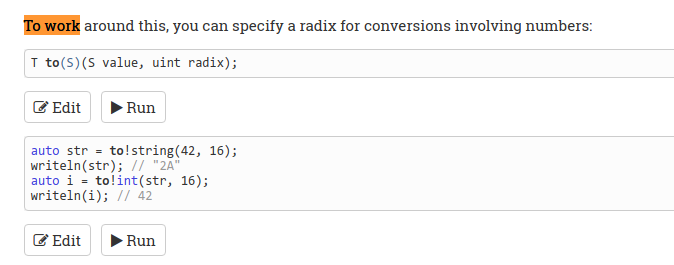
* _To work around this, you can specify a radix for conversions involving numbers.
* To work around this, you can specify a radix for conversions involving numbers:
* $(D_CODE T $(DDOC_PSYMBOL _to)$(DDOC_TEMPLATE_PARAM_LIST (S))(S value, uint radix);)
Copy link
Contributor

Choose a reason for hiding this comment

The reason will be displayed to describe this comment to others. Learn more.

Looks a bit weird on the docs:

image

and again no precedent of manually specifying the overload in the plain-text docs.

*/
@safe pure unittest
{
Expand Down Expand Up @@ -387,13 +389,14 @@ template to(T)
* $(LI $(D char), $(D wchar), $(D dchar) _to a string type.)
* $(LI Unsigned or signed integers _to strings.
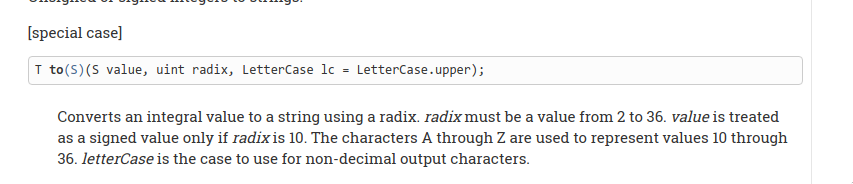
* $(DL $(DT [special case])
* $(DD Convert integral value _to string in $(D_PARAM radix) radix.
* radix must be a value from 2 to 36.
* value is treated as a signed value only if radix is 10.
* The characters A through Z are used to represent values 10 through 36
* and their case is determined by the $(D_PARAM letterCase) parameter.)))
* $(D_CODE T $(DDOC_PSYMBOL _to)$(DDOC_TEMPLATE_PARAM_LIST (S))(S value, uint radix, LetterCase lc = LetterCase.upper);)
* $(DD Converts an integral value _to a string using a radix.
* $(D_PARAM radix) must be a value from 2 _to 36.
* $(D_PARAM value) is treated as a signed value only if $(D_PARAM radix) is 10.
* The characters A through Z are used _to represent values 10 through 36.
* $(D_PARAM letterCase) is the case _to use for non-decimal output characters.)))
Copy link
Contributor

Choose a reason for hiding this comment

The reason will be displayed to describe this comment to others. Learn more.

Before:

image

After:

image

* $(LI All floating point types _to all string types.)
* $(LI Pointer to string conversions prints the pointer as a $(D size_t) value.
* $(LI Pointer _to string conversions prints the pointer as a $(D size_t) value.
* If pointer is $(D char*), treat it as C-style strings.
* In that case, this function is $(D @system).))
*/
Expand Down Expand Up @@ -6251,7 +6254,7 @@ private auto hexStrImpl(String)(scope String hexData)


/**
* Convert integer to a range of characters.
* Converts integer to a range of characters.
* Intended to be lightweight and fast.
*
* Params:
Expand Down