Fix random audio dropouts and corruption of audio data (2/2)#5993
Fix random audio dropouts and corruption of audio data (2/2)#5993floele wants to merge 2 commits intoobsproject:masterfrom
Conversation


 WizardCM
added
Bug Fix
WizardCM
added
Bug Fix


 RytoEX
left a comment
RytoEX
left a comment
RytoEX
left a comment
There was a problem hiding this comment.
Please wrap your commit message bodies at 72 characters, per our Commit Guidelines in our Contributing Guidelines.
In the future, please include "Fixes #<Issue Number>" in your PR description to automatically link the PR to whatever GitHub Issue(s) it may fix. I have manually linked this to Issue #4600. See these for more information:
- https://docs.github.com/en/issues/tracking-your-work-with-issues/linking-a-pull-request-to-an-issue
- https://docs.github.com/en/get-started/writing-on-github/working-with-advanced-formatting/using-keywords-in-issues-and-pull-requests
Generally, it's a good idea to keep your branch up-to-date with the branch that you're submitting it to by rebasing before submitting it. Please rebase this when you're able to do so.
 floele
force-pushed
the
fix-audio-v27
branch
from
floele
force-pushed
the
fix-audio-v27
branch
from
9875b64 to
25ec6bf
Compare
Previously, source->next_audio_ts_min was incremented by
conv_frames_to_time(sample_rate, in.frames) in each call of
source_output_audio_data(), so only by the duration of the audio
data itself.
However, this does not take the current timestamp into account,
which also includes execution time (audio source timestamps are
not necessarily continuous).

This causes the incoming audio timestamp to gradually deviate further
from the expected next_audio_ts_min timestamp, eventually exceeding
TS_SMOOTHING_THRESHOLD and then causing a call to
source_output_audio_place() which either overwrites existing audio
data and causes a glitch or puts data beyond the end of the buffer,
inserting a gap and thus causing a dropout.

Now use incoming timestamp for calculation of the next minimum
timestamp.
floele
force-pushed
the
fix-audio-v27
branch
from
25ec6bf to
47a78d1
Compare
|
Branch now rebased and commit messages wrapped. BTW, where would I find the compiled packages that include these changes? |

|
If you click the "CI Multiplatform Build" section of our actions page, you can find the latest build from your pull request there with artifacts at the bottom of the page. Example: https://github.com/obsproject/obs-studio/actions/runs/1878408431 |
floele
force-pushed
the
fix-audio-v27
branch
2 times, most recently
from
f34e7c8 to
86d03b5
Compare

|
Additional changes I have been thinking about:
|


|
I tested with my test audio generator (https://github.com/norihiro/obs-asynchronous-audio-source/) and seeing ~20ms silences like waveform below.
Note that above test audio might make something different from the actual issue. |
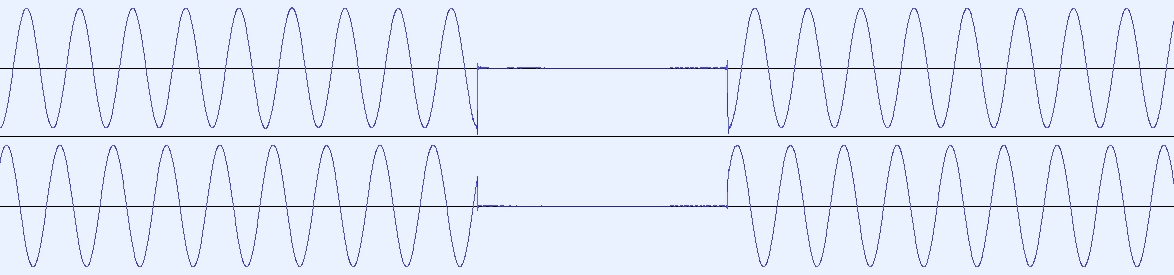
Yes, that is possible. As far as I can see, there isn't really anything wrong with the timestamps when these issues occur, so I would not consider the audio source being the source of the problem. I had someone make a 9 h test recording without issues a few days ago who previously reproduced the problem reliably, so I think the problem is fixed. Still concerned about breaking anything else with these changes though. |
|
Reading the code, I'd like to raise possible concerns.
|
I don't think I understand, can you give me an example?
That is true and I was a bit concerned about that initially, however,
Good point, should we just |
|
> * `audio_time` is now inconsistent with `samples`.
I don't think I understand, can you give me an example?
Prior to this change, `samples` and `audio_time` are updated at the same time. With this change, only `audio_time` gets updated if `input_and_output` returns false.
> * The `audio_callback` function is expected to be called every 1024 audio sample time (~21 ms for 48kHz) according to [the document](https://obsproject.com/docs/backend-design.html?highlight=audio_callback). This change will break the behavior when `audio_callback` returns `false`.
That is true and I was a bit concerned about that initially, however, `os_sleep_ms()` is not guaranteed to sleep *exactly* 21 ms anyway. So if a lack of accuracy was a problem, it should already have been noticed.
The prior code below was calling `input_and_output` at exactly `rate/1024` times per second on average. Even though `os_sleep_ms` is not accurate, the control `while (audio_time <= cur_time)` adjusted the time to call `input_and_output`.
```
while (os_event_try(audio->stop_event) == EAGAIN) {
uint64_t cur_time;
os_sleep_ms(audio_wait_time);
cur_time = os_gettime_ns();
while (audio_time <= cur_time) {
samples += AUDIO_OUTPUT_FRAMES;
audio_time = start_time + audio_frames_to_ns(rate, samples);
input_and_output(audio, audio_time, prev_time);
prev_time = audio_time;
}
}
```
So, my understanding is that the code is equivalent to the code below except less overhead of `os_sleepto_ns`.
```
while (os_event_try(audio->stop_event) == EAGAIN) {
os_sleepto_ns(audio_time);
samples += AUDIO_OUTPUT_FRAMES;
audio_time = start_time + audio_frames_to_ns(rate, samples);
input_and_output(audio, audio_time, prev_time);
prev_time = audio_time;
}
```
> * The loop always waits `audio_wait_time` so that there is a possibility `audio_time` is incremented twice.
> If the function `input_and_output` returns `false` when the loop is about to happen twice,
> `audio_time` won't reach `cur_time` and will cause high-CPU usage until new audio data arrives.
Good point, should we just `break;` the inner loop in that case? Or rather add an additional `sleep()`, maybe with a smaller duration than in the main loop?
I think the problem is how to handle audio when the audio source sends less samples or more samples than the output requires. Unfortunately I don't have a clear vision on how to fix in libobs so far.
I'd like to leave further discussion for the initial author of the function, maybe Jim.
|
OK I see what you mean now. I could change that, but if we're still discussing the general approach to problem, it probably makes sense to wait with further adjustments until we have decided? Another approach I could imagine is to not use a constant |
|
Also one more option: Since we are dealing with two separate issues here, we could also split the PR and merge the first commit if that one is undisputed. |

|
Yep that sounds like a logical next step. |
floele
changed the title
|
OK, did that now. First part is #6133 |

If the audio buffer is not currently sufficiently filled (at least
AUDIO_OUTPUT_FRAMES), process_audio_source_tick() does not put any
data into audio_output_buf.
However, input_and_output() still executes do_audio_output(), taking
exactly AUDIO_OUTPUT_FRAMES from the buffer, causing an audio dropout.

Now return false in audio_callback() if any audio source is still
pending and prevent further processing.

Co-Authored-By: Norihiro Kamae <norihiro@nagater.net>

|
Hey there good ppl! Did this issue get resolved yet? I'm currently recording musical live jams with OBS and get these random 20ms silences like described in this issue every now and then. |
|
@plektron89 Not to my knowledge. We had to stop testing because OBS wasn't in a stable state at that point. Probably makes sense to look into that again now to check if at least one of my two proposed fixes helps. |

|
@plektron89 |
|
thank you both for the quick reply! @dojima Do you also do musical live streams or recordings with this? I mean sure its one sample being added or removed but when I think about what effort goes into getting the "best" or "truest" sound.. I don't know if I can live with that... :'D I may need to give it a try but I guess I'd rather take the hassle and record into logic at the same time.. |
|
@plektron89
I'm no expert, but I tend to agree that no one could ever possibly notice. |
|
@dojima Ok I tried it out but I still get those silences.. if anything I think it got more frequent.. :/ I'm on a Mac using the replay buffer. Maybe that's an issue? Or maybe its Ladiocast which I need for routing... gotta try recording that output directly to logic. Hmmm really is a bummer for me.. other than that I really enjoy OBS so far. Hopefully I'll find a solution soon. |

| uint64_t cur_time; | ||
|
|
||
| os_sleep_ms(audio_wait_time); | ||
| if (wait_cycles > 0) { |

There was a problem hiding this comment.
I don't fully understand the purpose of these changes here:
- At first the thread waits the normal amount of time and then calls
input_and_outputto check if the expected number of samples were provided by the audio source - If that is the case, the timestamps are updated and the thread continues as before
- If that is not the case, the thread waits for half its usual cycle, then increments
wait_cycles(should be1before the next iteration) - On the next iteration, the thread waits for half the cycle again, then decrements
wait_cyclesagain (it should be0then).
As such it only seems to wait for half a circle to increment and decrement a single variable that otherwise has no impact on the code executed in the loop. Or am I missing something?

|
I'm not fully clear on which specific issue this PR (and its companion) are trying to fix or if it's just adding code that attempts to "hide" an underlying issue with sources not being able to keep up with OBS timing demands? I left a comment on part 1 (which scope I understand) but I'm not sure about what behaviour this PR tries to fix? If the device is not providing enough audio samples in time for OBS' audio renderer, there have to be cuts in the audio stream. But maybe I'm missing something here. |
|
Hi @PatTheMav , I personally believe that the audio devices are not to blame here as recording the same audio source using different software works perfectly fine without glitches. There should in general be sufficient audio samples and it just seems that temporary fluctuations of available audio samples is not handled well in OBS (which my code attempted to change). Additional to a second issue that is basically programmed to fail even if sufficient samples are always available (first commit). But I'm not an expert in this kind of applications and especially not familiar with the OBS codebase, so I lack some background information and may not entirely understand why it's happening. I can only say that it does happen, and any solution is fine for me. And it's been two years by now so whatever temporary deeper understanding I got while working on this is now certainly gone. So at this point I assume the most I can do is provide the observations and expectations. And I'm happy to do testing as well. But fixing it properly should probably be left to the project maintainers or whoever knows what they're doing. |
The main issue is that recording is an asynchronous operation, so even if buffers aren't filled in time, the writing of the recording can stall until enough data is available (the provider of data is effectively acting as the clock for the process). But OBS has an equally strong focus on live-streaming which doesn't allow for stalls (data has to arrive in time). If a device can't fill a buffer in time, OBS still has to produce a stream packet in time and if there's not enough audio data, that packet will then have "empty" data. One could argue that this system is ill-suited for recordings, but for better or worse OBS doesn't treat both scenarios much differently in its core architecture. Are there sure-fire steps to reproduce this issue? In my tests I wasn't able to reproduce your numbers because all my audio devices filled the samples in much less time than OBS allows so the timestamps always matched. |
|
Yes it is reliably reproducible on machines where it happens. See the linked issue for how I did it. It doesn't even involve an external audio device. |

| obs_source_audio_render(source, mixers, channels, sample_rate, | ||
| audio_size); | ||
|
|
||
| if (source->audio_pending && source->audio_ts) |

There was a problem hiding this comment.
While chasing a different audio bug, I found that the changes in this file appear to negatively affect A-V sync for some jittery sources. Due to the nature of how difficult it is to reproduce this bug, I am unable to practically investigate any further.
9 participants


(Draft PR since I'm trying to get a few more positive test results before merging).
Description
1) libobs: Fix corruption of audio data in audio_input_buf
Previously,
source->next_audio_ts_minwas incremented byconv_frames_to_time(sample_rate, in.frames)in each call ofsource_output_audio_data(), so only by the duration of the audio data which is basically a fixed value (ifin.framesdoesn't vary).However, this does not take the incoming audio timestamps into account, which also include execution time. In
ProcessCaptureData()for exampleos_gettime_ns()is used to generate the audio timestamp if device timestamps are off so it's unavoidable that the incoming timestamps are always a little later than the raw duration of the audio data. This also applies if device timestamps are enabled though, at least when recording from desktop audio (Windows 10) which I have used to verify the issue.This adds up, because
in.timestampis being set tosource->next_audio_ts_minbefore calculating the next timestampsource->next_audio_ts_min = in.timestamp + conv_frames_to_time(sample_rate, in.frames).If you watch the values over time, you can see the timestamps deviating like this (extract of a few thousand iterations):
So the incoming audio timestamps gradually deviate further from the expected
next_audio_ts_mintimestamp, eventually exceedingTS_SMOOTHING_THRESHOLDand then causing a call tosource_output_audio_place()which either overwrites existing audio data and causes a glitch or puts data beyond the end of the buffer, resizing it and inserting a gap and thus causing an audio dropout.Now
next_audio_ts_minis incremented based on the current incoming audio timestamp to prevent this issue.For testing purposes, this issue can be detected by looking for "frames: %lu, size: %lu, placement: %lu, base_ts: %llu, ts: %llu" debug messages (with DEBUG_AUDIO enabled).
2) libobs: Fix audio dropouts in input_and_output()
If the audio buffer is not currently sufficiently filled (at least
AUDIO_OUTPUT_FRAMES),process_audio_source_tick()does not put any data intoaudio_output_buf. This situation is also taken into consideration indiscard_audio()which will emit a debug message "can't discard, data still pending" (assumingDEBUG_AUDIO == 1) in this situation.However,
input_and_output()still executesdo_audio_output(), taking exactlyAUDIO_OUTPUT_FRAMESfrom the buffer, causing an audio dropout.The change now returns false in
audio_callback()if any audio source is still pending, so that further processing ininput_and_output()is prevented.For testing purposes, this issue can be detected by looking for "can't discard, data still pending" debug messages (with DEBUG_AUDIO enabled).
Motivation and Context
These two fixes solve the issues discussed in #4600.
In short, audio recorded or streamed by OBS contains random short dropouts or corruption, independently of settings and environment, though frequency may vary. The frequency of the issue occuring ranges from every couple of minutes to maybe once or twice per hour based on my observations and the reports in the mentioned issue.
How Has This Been Tested?
For my tests I use a test tone generator to record continuous uniform audio data with OBS (default settings, Windows 10). I then check the resulting audio stream for dropouts. For testing, I usually record 1 to 2 h of audio data.
I tried to make the changes so that the overall behaviour of the code changes as little as possible.
Types of changes
Checklist: