Move breeze commands to sub-commands #25449
Conversation


 potiuk
requested review from
ashb,
jedcunningham,
kaxil and
mik-laj
as code owners
potiuk
requested review from
ashb,
jedcunningham,
kaxil and
mik-laj
as code owners

|
cc: @edithturn @Bowrna - yet another step towards even better Breeze experience. |
|
This one looks big - but most of it is reshuffling the code around to account for moving the Breeze commands to subcommands. A lot of those changes are auto-generated screenshots. We already had the groups before, but the commands were cluttering a lot the initial help screen and they were not logically connected except the rich-click configuration. Now they are truly separated - including no back-reference from the sub-command to I used the opportunity to also refactor Breeze docs to follow the Now it is all much cleaner, neater, logical, smaller and isolated. I kept invisible aliases to the commands that people could get used to. New main breeze help is much more readable now:
And documentation flow is much more logical:
|
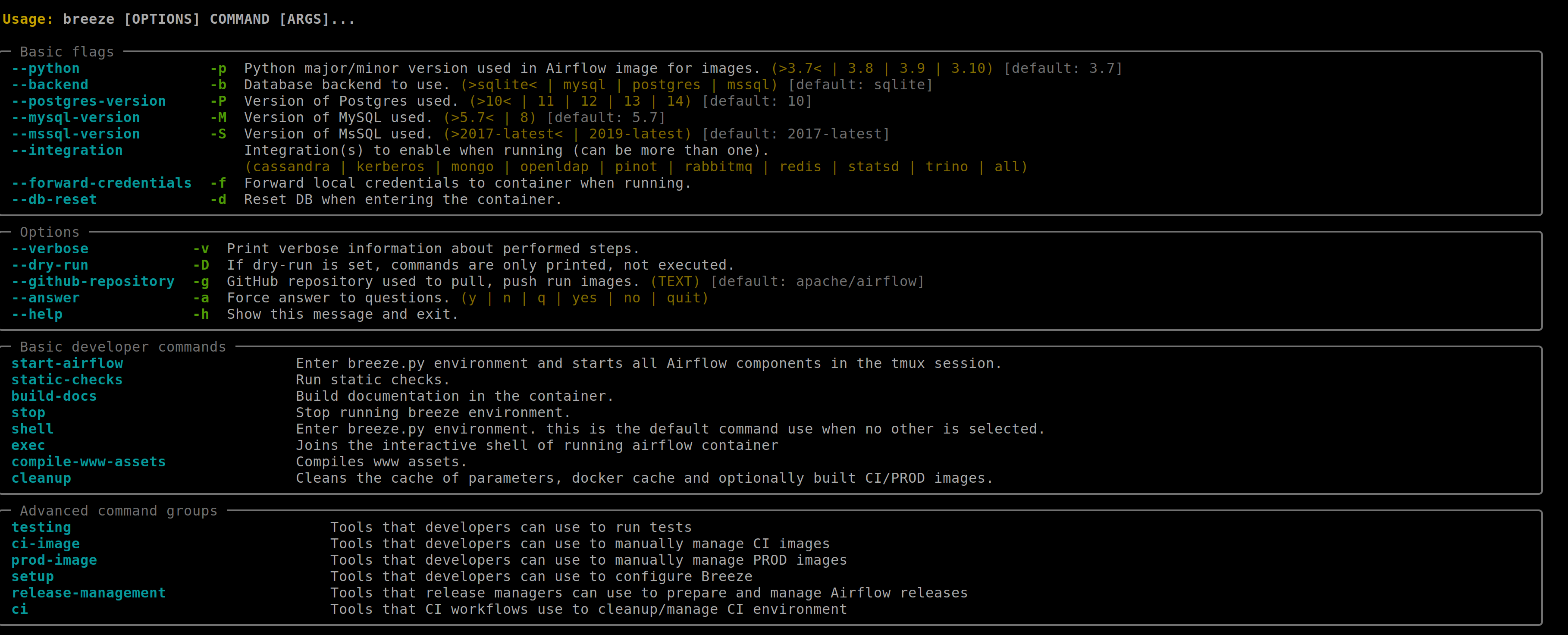
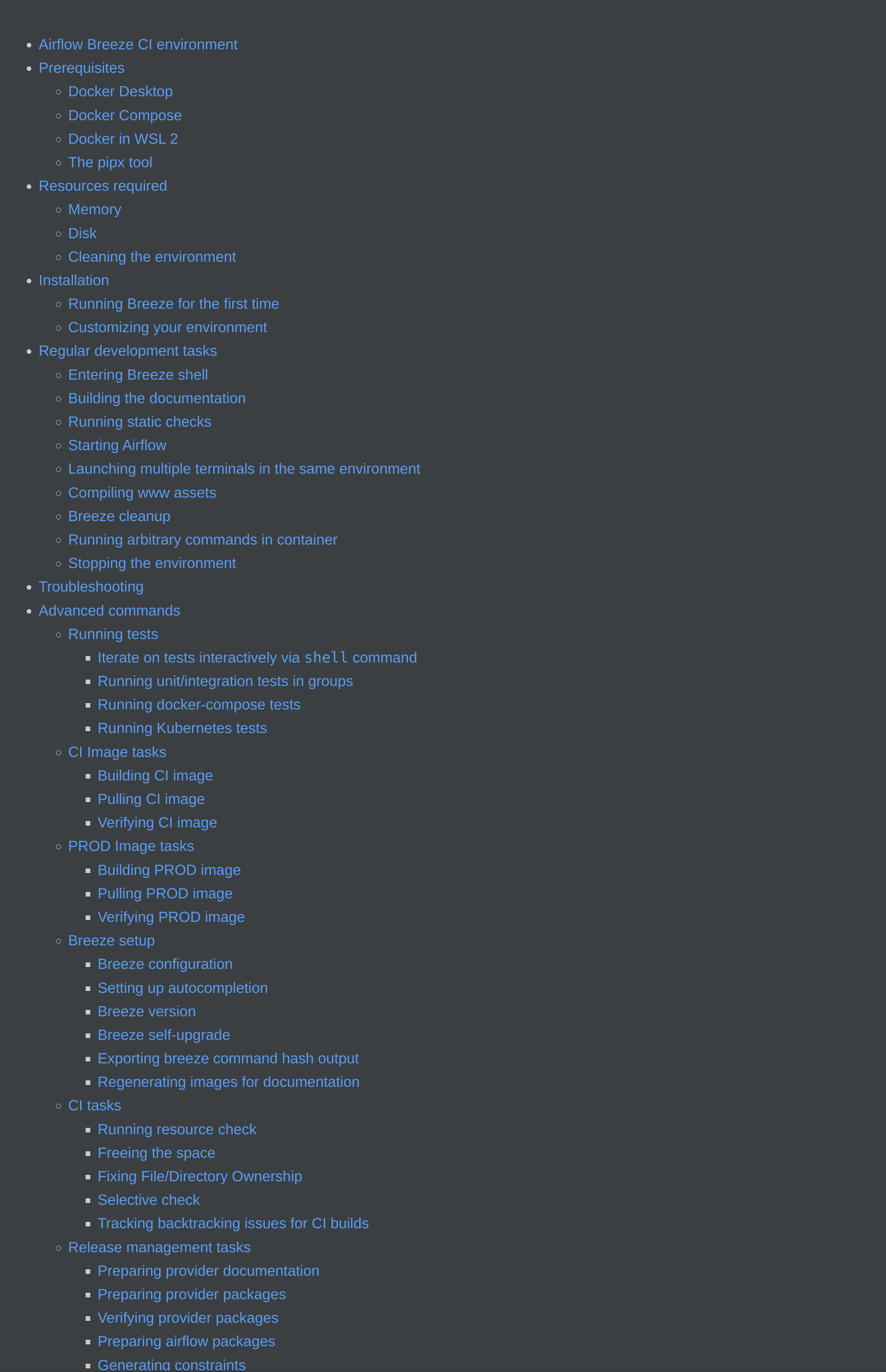
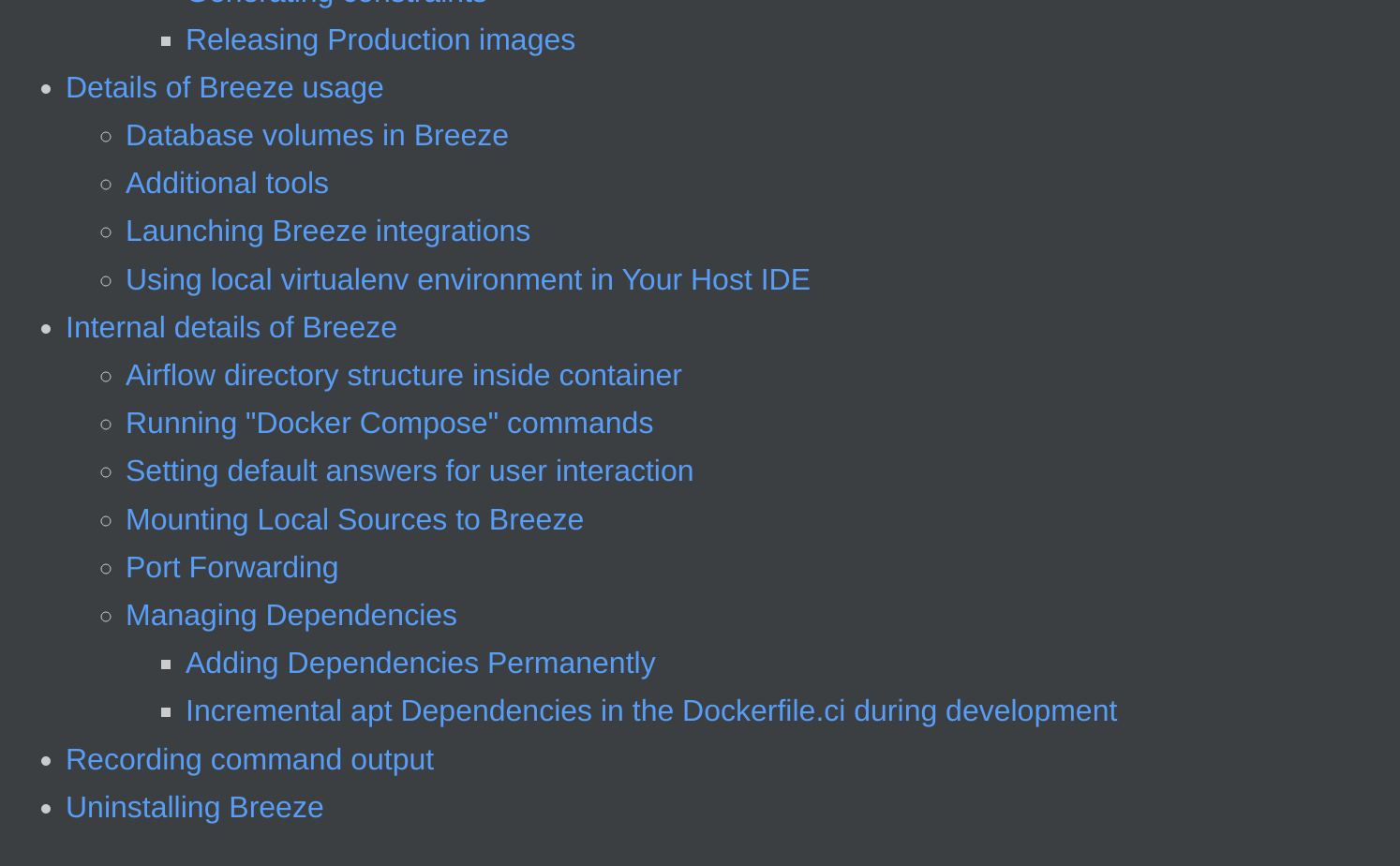

|
@potiuk I have successfully run through the I have noticed that the output no longer wraps properly in terminals less than 180 characters wide. I'm not much of an expert in click, so I'm not sure how to fix this. I suspect Here is what I get when running breeze from And here is what I get when running breeze from your branch: I haven't reviewed any of the CI stuff, FYI. Not sure I understand it well enough to contribute much there. |
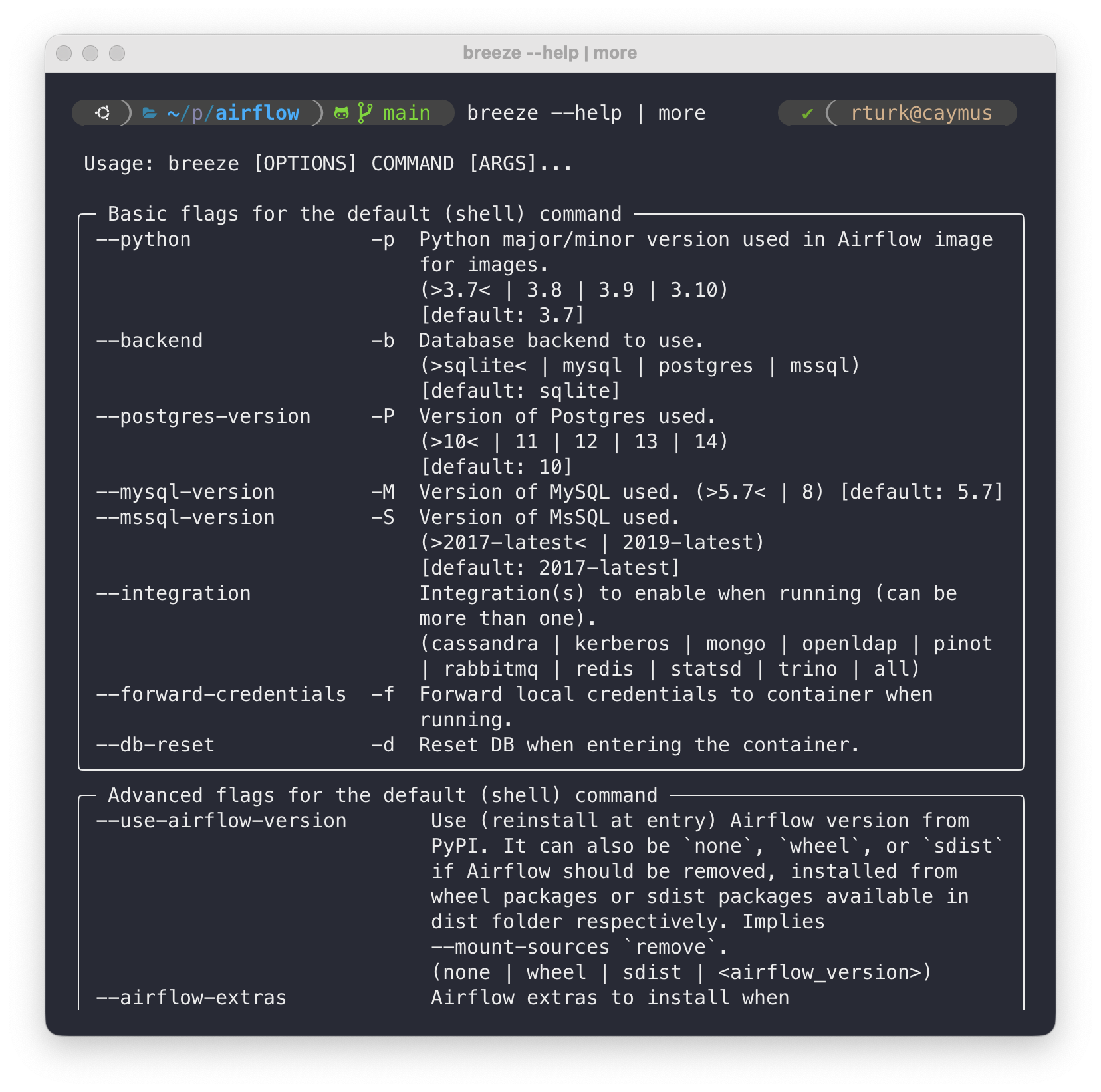
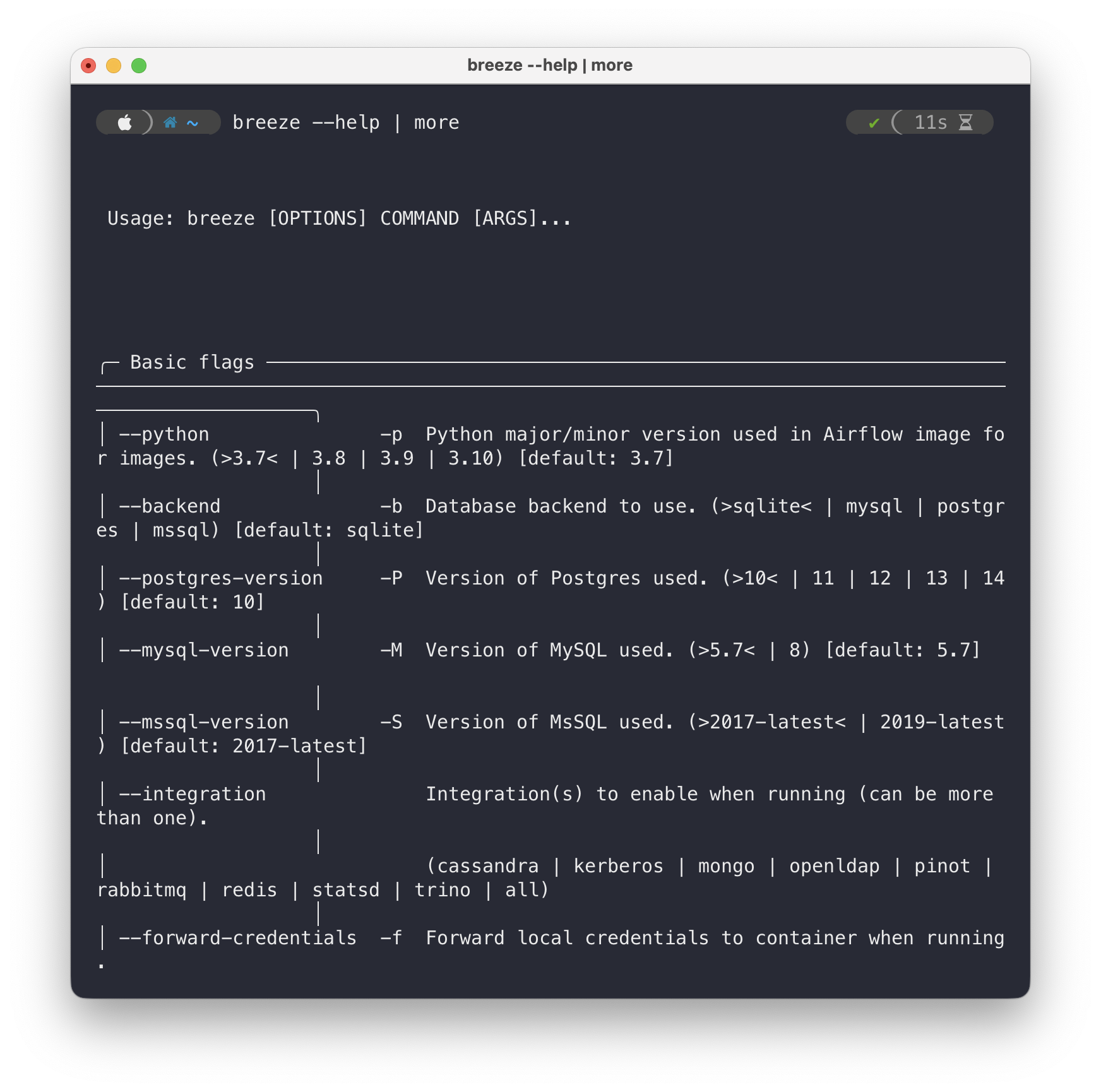
|
Yeah. The 180 is a new feature in rich click -but It's not needed at all. I can remove it. Thanks @rossturk for looking at it :) |
potiuk
force-pushed
the
move-breeze-commands-into-groups
branch
from
9a822db to
a8ff64e
Compare
|
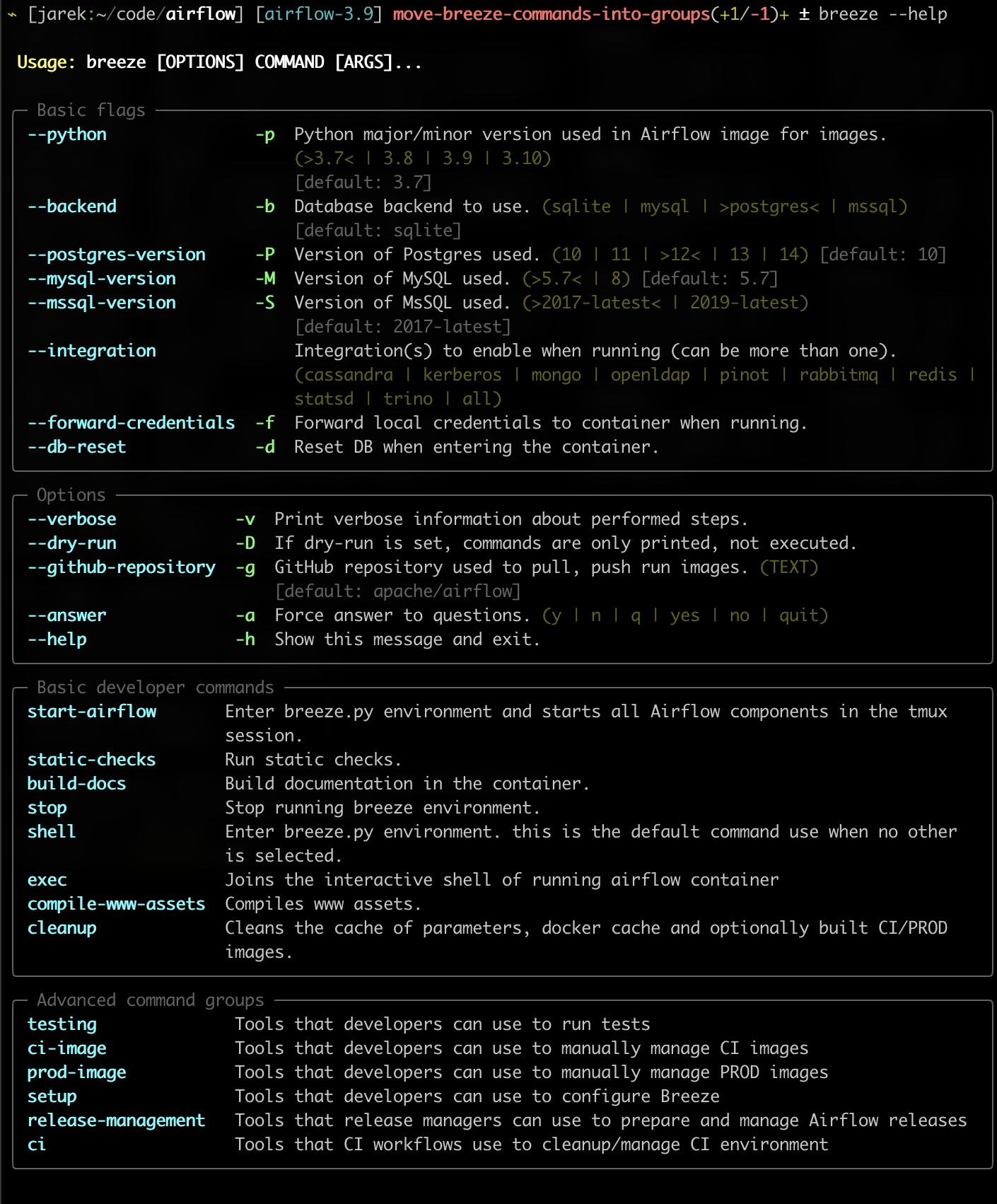
Much better indeed.
|
|
One thing I am a bit torn - should "advanced command group" be before or after "Basic developer commands" - the nice thing about having "basic" commands at the end is that they are "last" - i.e. possibly easier to find WDYT (those who would look at it :) ? |

I prefer the way it's arranged now. More like a natural order :) |
Yeah. That's why I am on the fence :) |
potiuk
force-pushed
the
move-breeze-commands-into-groups
branch
from
a8ff64e to
a14dd04
Compare
|
BTW. I also reviewed the flags for all commands and made sure that the flags are "classified" properly for each command. There were a few flags that have fallen into default "options" and the only ones we want there some really common options like --verbose, --github-repository and so on. |
potiuk
force-pushed
the
move-breeze-commands-into-groups
branch
from
a14dd04 to
82587e8
Compare

+1 |

 blag
left a comment
blag
left a comment
blag
left a comment
There was a problem hiding this comment.
Yeah, I think keep the basic commands above the advanced commands. If we can get rich to display it in a brighter/lighter gray to make it stand out a bit, that would also be a subtle indicator that people could key off of.
With breeze ci-image and breeze prod-image, the subcommands also have a -image suffix. This seems a little unnecessary and redundant to me, but it might feel more familiar to people who are transitioning from using the previous commands. Maybe just breeze prod-image build and breeze ci-image build? Same story with breeze prod-image verify-image, breeze ci-image verify-image, and breeze ci-image pull-image. This is just a nitpick, so just something to consider.
I am not sure about that one, I looked into some rich-click integration for other stuff (finding out if we have not missed some commands) and the formatting is not really configurable. We can distinguish commands from options, but not the "top-level" commands from "command groups" - they are collectively under _COMMANDS :(. Without copy-pasting rich-click code we cannot do much about it, I am afraid, so leaving it as is now is probably good-enough option.
I like this one. Let me change it :). We have good opportunity to change stuff now. |

|
Other than those nitpicks, this LGTM. 👍 |
potiuk
force-pushed
the
move-breeze-commands-into-groups
branch
from
82587e8 to
696c281
Compare
Originally Python version of Breeze had only a handful of commands,
while moving from Bash, but we are close to completion of the
transition and the number of commands grew quite a lot bringit it
on par to the commands we used to have in the Bash version of Breeze.

However, only a small subset of the commands is actually useful to
average developer, most of the more advanced commands are used in
specific circumstances (release management, configuring Breeze
once or rebuilding the image or even runing non-interactive test
session are rarely used. Therefore it makes much more sense to
surface the common commands as the top-level commands and move
the less frequent commands to subcommands to move them out from
the main help page.

At the same time, the BREEZE.rst documentation got a little messy
during the move and this is the right time to structure it similarly
to breeze commands:

* prerequisites and installation
* first-time configuration
* regular task description
* more advanced tasks grupped in the same subcommands as in Breeze
* diving deeper into details of Breeze implentation for those
  who wish to understand how Breeze works under-the-hood

Aliases for the common commands that users could already get used to
were created, and deprecation warnings are printed in casee those
commands are used (guiding the user to the new commands to use).

Less frequently used options for shell command are still available
in `shell` but they have been removed from the default command to
remove clutter. You can still used them by explicitly specifying
the `shell` commnd.

Configuration for rich click has been separated out from the
command group implementation to separate packages. This allows
for less problems with circular imports - none of the commands
are needed when rich-click configuration is being prepared, which
happens before main `click` command is parsed, which allows to
run imports of the "code" as late as possible.
potiuk
force-pushed
the
move-breeze-commands-into-groups
branch
from
696c281 to
31fb5ff
Compare
|
Anyone else? That one looks green :) |


* mOve breeze commands to sub-commands

Originally Python version of Breeze had only a handful of commands,
while moving from Bash, but we are close to completion of the
transition and the number of commands grew quite a lot bringit it
on par to the commands we used to have in the Bash version of Breeze.

However, only a small subset of the commands is actually useful to
average developer, most of the more advanced commands are used in
specific circumstances (release management, configuring Breeze
once or rebuilding the image or even runing non-interactive test
session are rarely used. Therefore it makes much more sense to
surface the common commands as the top-level commands and move
the less frequent commands to subcommands to move them out from
the main help page.

At the same time, the BREEZE.rst documentation got a little messy
during the move and this is the right time to structure it similarly
to breeze commands:

* prerequisites and installation
* first-time configuration
* regular task description
* more advanced tasks grupped in the same subcommands as in Breeze
* diving deeper into details of Breeze implentation for those
  who wish to understand how Breeze works under-the-hood

Aliases for the common commands that users could already get used to
were created, and deprecation warnings are printed in casee those
commands are used (guiding the user to the new commands to use).

Less frequently used options for shell command are still available
in `shell` but they have been removed from the default command to
remove clutter. You can still used them by explicitly specifying
the `shell` commnd.

Configuration for rich click has been separated out from the
command group implementation to separate packages. This allows
for less problems with circular imports - none of the commands
are needed when rich-click configuration is being prepared, which
happens before main `click` command is parsed, which allows to
run imports of the "code" as late as possible.

* Update manage-dags-files.rst

(cherry picked from commit b91fd99)
 ephraimbuddy
added
type:misc/internal
ephraimbuddy
added
type:misc/internal

7 participants


Originally Python version of Breeze had only a handful of commands,
while moving from Bash, but we are close to completion of the
transition and the number of commands grew quite a lot bringit it
on par to the commands we used to have in the Bash version of Breeze.
However, only a small subset of the commands is actually useful to
average developer, most of the more advanced commands are used in
specific circumstances (release management, configuring Breeze
once or rebuilding the image or even runing non-interactive test
session are rarely used. Therefore it makes much more sense to
surface the common commands as the top-level commands and move
the less frequent commands to subcommands to move them out from
the main help page.
At the same time, the BREEZE.rst documentation got a little messy
during the move and this is the right time to structure it similarly
to breeze commands:
who wish to understand how Breeze works under-the-hood
Aliases for the common commands that users could already get used to
were created, and deprecation warnings are printed in casee those
commands are used (guiding the user to the new commands to use).
Less frequently used options for shell command are still available
in
shellbut they have been removed from the default command toremove clutter. You can still used them by explicitly specifying
the
shellcommnd.Configuration for rich click has been separated out from the
command group implementation to separate packages. This allows
for less problems with circular imports - none of the commands
are needed when rich-click configuration is being prepared, which
happens before main
clickcommand is parsed, which allows torun imports of the "code" as late as possible.
^ Add meaningful description above
Read the Pull Request Guidelines for more information.
In case of fundamental code changes, an Airflow Improvement Proposal (AIP) is needed.
In case of a new dependency, check compliance with the ASF 3rd Party License Policy.
In case of backwards incompatible changes please leave a note in a newsfragment file, named
{pr_number}.significant.rstor{issue_number}.significant.rst, in newsfragments.