Rough wall boundary condition for SA and SST turbulence models. #877
Conversation


|
Let me know if you need any help merging with develop @koodlyakshay, I had a quick look and it seems to be mostly a matter of copy pasting the new numerics options you added into the split files introduced in #861. |

 pcarruscag
left a comment
pcarruscag
left a comment
pcarruscag
left a comment
There was a problem hiding this comment.
Few comments based on aforementioned quick scroll through.

|
Thanks for the comments @pcarruscag. I fixed them. I will work on merging with develop soon. |


 talbring
left a comment
talbring
left a comment
talbring
left a comment
There was a problem hiding this comment.
Thanks @koodlyakshay ! I just have some small comments below.
pcarruscag
left a comment
pcarruscag
left a comment
There was a problem hiding this comment.
Few more comments here and there as I dive into the nitty-gritty stuff.
|
@pcarruscag thanks for the comments. I have fixed most of them I think. In general, I think the PR is ready to be reviewed. I will think of a decent test case and add it soon. |
pcarruscag
left a comment
pcarruscag
left a comment
There was a problem hiding this comment.
Thanks, LGTM, just please have a look at the 4 variables that are possibly not being de-allocated (deleted) and revert travis.yml.

|
|
||
| inline void CBaseMPIWrapper::Allgatherv(void *sendbuf, int sendcnt, Datatype sendtype, | ||
| void *recvbuf, int recvcnt, int *displs, Datatype recvtype, Comm comm){ | ||
| void *recvbuf, int *recvcnt, int *displs, Datatype recvtype, Comm comm){ |
There was a problem hiding this comment.
This was the problem, the signature was incorrect, I've had some issues (weird segfaults) in the past with AD and allgatherv by the way... not because of this problem, and maybe it was my fault... But anyway just something to keep in the back of your mind if it causes you problems too.

|
Thanks for the fix @pcarruscag. |
|
Can I merge this one? |


|
Hello everyone. I ran simulations with the file “turb_flatplate_v7_cfg.txt”, but the results obtained do not converge with those presented in Blanchard's Figure of numerical results and experiments. I also ran simulations with different values of speed and roughness, but the results did not converge either. Could you please help me? Thank you! |


Proposed Changes
This PR is about the implementation of a rough wall boundary condition for SA and SST models. A given realistic roughness distribution must be first converted to an "equivalent sand grain roughness" height and specified as an input.
For the SA turbulence model, the roughness boundary condition is based on:
Aupoix, B. and Spalart, P. R., "Extensions of the Spalart-Allmaras Turbulence Model to Account for Wall Roughness," International Journal of Heat and Fluid Flow, Vol. 24, 2003, pp. 454-462.
Very briefly, the new model assumes there is a "virtual wall" located on top of the roughness elements and thus the distance to nearest wall is modified for all points based on the specified sand grain roughness. Additionally, the boundary condition at the wall is now not set to zero but a mixed condition (robin BC) is applied allowing for a non-zero eddy viscosity at the wall. More information is also available here
For the SST model, the roughness boundary condition is based on:
Wilcox, D.C Turbulence Modeling for CFD., 1998 and 2006, DWC Industries
There are two suggestions (first in the 2nd edition and a corrected version in the 3rd edition). I have implemented the latest one and commented the old one. There have been numerous papers about some limitations of these models themselves however. The modification consists of changing the omega boundary condition at the wall to a different value based on local quantities.
This PR introduces two extra config options - one to specify whether a wall is rough or not and another to specify the sand grain roughness height for each of them.
By default all walls are smooth. If neither option is present in the config file, smooth walls are assumed everywhere. However, if there are multiple walls some rough, some smooth, they need to be listed (similar to INLET TYPE) in the order they appear in the MARKER_HEATFLUX definition. I have attached some examples here.
Here is the input file turb_flatplate_v7_cfg.txt,
The meshes can be found in TestCases/rans/flatplate or the NASA TMR database. Here are the results with both SA and SST
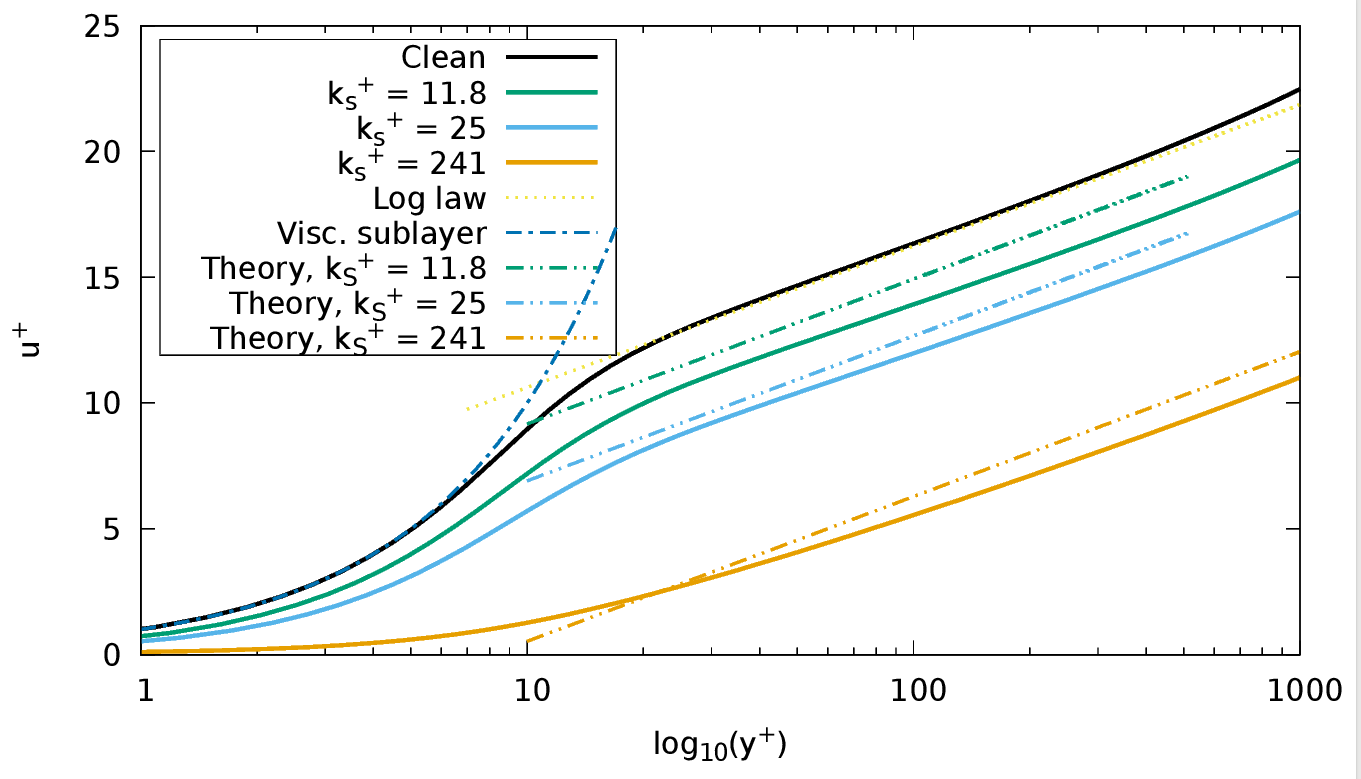
Here I am plotting the non-dimensionalised velocity u^+ against y^+. The clean results give fairly good agreement and we can see some over prediction in velocity shifts. This was also reported elsewhere
The same plot for SST. The results are not quite as good as SA in general, but I expected that considering some limitations reported in the literature (ex a min y^+ ~ 0.01 and so on).
Here is a comparison against experimental data by Blanchard (1977)
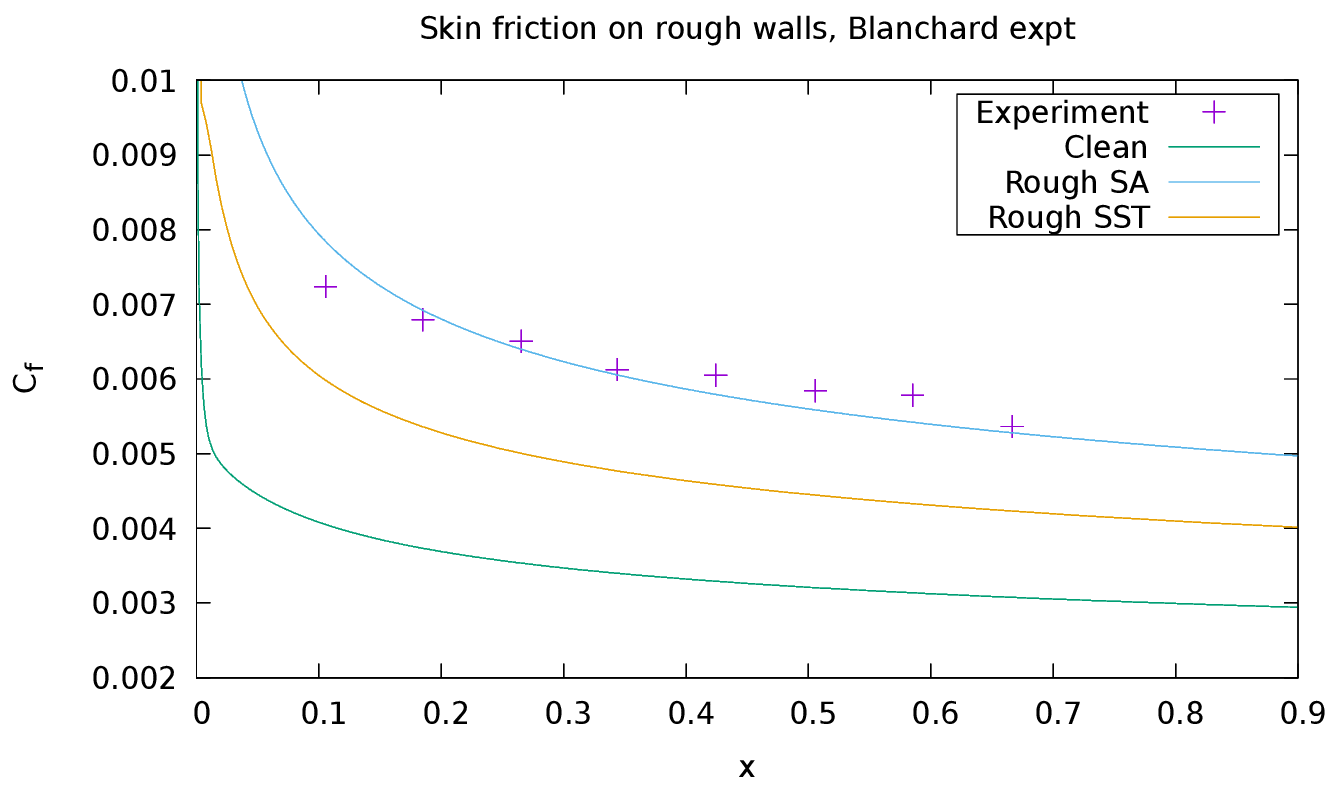
Once again, the SA roughness model does fairly well as opposed to the SST.
If only a part of the wall is rough, as is the case on airfoils with corrosion for ex, we can split the marker definition as follows:
In case there is even a single rough wall, the WALL_TYPE option must specified for all the markers and WALL_ROUGHNESS set to 0.0 for smooth walls and the desired value for rough walls.
Sample input file for airfoil with smooth and rough walls. The airfoil used here is the NACA 622215 and I can send the mesh and experimental data in case anyone is interested.
Additional notes
Modification of wall distance computation required some changes to the ADT routines and subsequently to some FEM stuff as well. To modify the wall distance with roughness, I needed to know which marker was the closest wall and add the corresponding roughness. However, I wasn't sure how to properly do this in MPI. My solution was to pass the marker roughness information to the ADT class itself. This meant I had to add a dummy argument whenever the corresponding ADT classes were called elsewhere. Just to clarify, the modification is only in CADTElem class constructor and ComputeWallDistance routines. I hope this will not be a problem. I made this as a draft PR in case there are some issues with this. Also, if there are any issues with how the config file is changed, I can update that as well. I haven't modified the config_template for this yet.
PR Checklist
Put an X by all that apply. You can fill this out after submitting the PR. If you have any questions, don't hesitate to ask! We want to help. These are a guide for you to know what the reviewers will be looking for in your contribution.